


 PLATFORM UPDATE:


Triazine-functionalized donor–π–acceptor covalent organic frameworks with oligo(phenylenevinylene) bridge for efficient photocatalytic H2O2 evolution
 *ac
Daqiang
Yuan
*acd
*ac
Daqiang
Yuan
*acd
Abstract
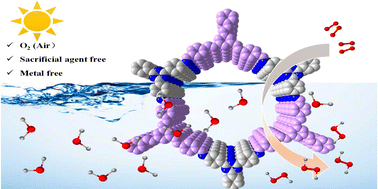
Hydrogen peroxide (H2O2) is an important green oxidant, yet its conventional anthraquinone-based synthesis remains environmentally burdensome. Photocatalytic production offers a sustainable alternative, though it is limited by the lack of efficient catalysts. Covalent organic frameworks (COFs), with their tunable structures and electronic properties, show great promise in this regard. Here, we designed and synthesized a triazine-functionalized donor–π–acceptor (D–π–A) covalent organic framework, OPV-TAPT-COF, which strategically employs an oligo(phenylenevinylene) (OPV) unit as the conjugated bridge, for photocatalytic H2O2 generation. The material achieves a high H2O2 production rate of 3094 μmol g−1 h−1 under visible light in pure water and air, without the use of any sacrificial agents. Experimental and theoretical results reveal that the synergistic interplay between the OPV bridge and the triazine acceptor is crucial: the extended OPV π-conjugation broadens light absorption and enables efficient charge migration, while the strong electron-withdrawing triazine unit not only creates a powerful built-in electric field for charge separation but also serves as an optimal active site for the oxygen reduction reaction, thereby significantly lowering the energy barrier for the critical *OOH intermediate formation. These features collectively boost catalytic performance and highlight the material's practical potential.
 Please wait while we load your content...


