


 PLATFORM UPDATE:


Flexible zinc–air batteries with one-step gel electrolyte featuring high performance and environmental adaptability

Abstract
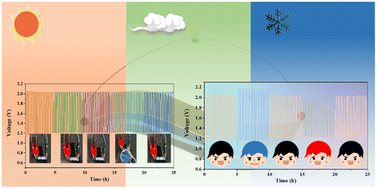
Flexible zinc–air batteries (ZABs) are highly attractive for next-generation wearable electronics owing to their high theoretical energy density, intrinsic safety, and low cost. However, conventional gel electrolytes often suffer from poor ionic conductivity, structural instability under deformation, and complex post-treatment procedures such as KOH soaking. To address these limitations, this work proposes a novel QCS–PAA–NaCl ternary hydrogel synthesized via a one-step in situ polymerization process, eliminating the need for additional alkaline soaking and ensuring uniform electrolyte distribution. The incorporation of quaternized chitosan (QCS) introduces abundant –N+(CH3)3 groups, enhancing ion conduction and interfacial compatibility, while NaCl acts as an ionic additive that promotes charge transport and reinforces the hydrogel network. Benefiting from the synergistic interaction between QCS and NaCl, the hydrogel exhibits high ionic conductivity (217 mS cm−1) and excellent flexibility across a wide temperature range (−20 to 60 °C). When applied to flexible ZABs, the device delivers a peak power density of 114.2 mW cm−2 and stable cycling over 115 h, outperforming most reported counterparts. This strategy offers a promising platform for high-performance, temperature-tolerant ZABs tailored for wearable and deformable electronics.
 Please wait while we load your content...


