


 PLATFORM UPDATE:


Systematic evaluation of plasma and reactor parameters in non-thermal dielectric barrier discharge plasma ammonia synthesis

Abstract
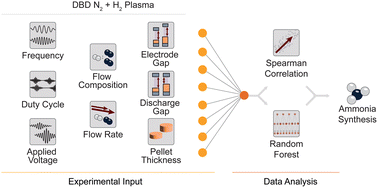
Dielectric barrier discharge (DBD) plasmas provide an electrified, nonequilibrium route to ammonia synthesis that can be directly powered by renewable electricity. However, the coupled effects of reactor geometry, operating conditions, and microdischarge on plasma characteristics and process performance remain poorly understood. Here, we present a comprehensive study of N2–H2 conversion in a DBD reactor, systematically varying the barrier thickness (1.0–2.0 mm and empty-cell reference), electrode and discharge gaps, applied voltage, gas composition, flow rate, and pulse timing parameters. Integrated diagnostics, including Lissajous power analysis, microdischarge statistics, optical emission spectroscopy of N2, N2+, and NH, and colorimetric NH3 quantification, are combined with statistical correlation and machine-learning (Random Forest) analyses. We show that the reactor geometry governs the microdischarge charge and energy distributions through capacitive coupling, while the residence time and pulse timing regulate the excitation partitioning across the electronic, ionic, and dissociative channels. Gas composition further determines the balance between nitrogen excitation and radical generation pathways. Ammonia yields correlate most strongly with NH(A → X) emission intensity and scale with microdischarge dynamics, linking discharge structure directly to nitrogen activation efficiency. This parameter-mapped framework provides mechanistic design rules for tuning plasma reactors and advances the development of sustainable, decentralised ammonia synthesis under mild conditions.
- This article is part of the themed collections: Green and sustainable synthesis and catalysis, 2026 Green Chemistry Hot Articles and Green Chemistry Emerging Investigators Series
 Please wait while we load your content...


