


 PLATFORM UPDATE:


Electrocatalytic oxidation of 1,2-cyclohexanediol to adipic acid with high faradaic efficiency under high current density over a CoFe2O4@CuO/CF catalyst

Abstract
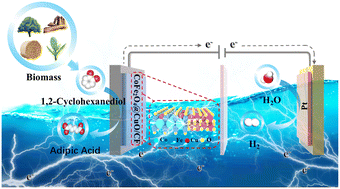
Adipic acid (AA) is an important chemical raw material used to prepare polymers (nylon-66). The traditional preparation method relies on a strong oxidation to produce AA. However, these methods are limited by environmental pollution, fossil fuel dependence, and low conversion efficiency and selectivity. Herein, we report an electrocatalytic strategy for the oxidation of biomass-derived 1,2-cyclohexanediol (CHD) to AA and the production of H2 on a CoFe2O4@CuO/CF hierarchical heterostructure nanoarray catalyst. The hierarchical array structure is composed of CuO nanowire arrays grown on the surface of copper foam (CF), and then CoFe2O4 nanosheets are further grown on CuO nanowires. Remarkably, the CoFe2O4@CuO/CF exhibited top-level activity for the electrooxidation of CHD to AA (10 mA cm−2 at 1.20 V vs. RHE), with 93.8% CHD conversion rate, 84.8% AA selectivity, outstanding Faraday efficiency (FE) of 88.9%, and long-term stability (120 h). The improved electrocatalytic performance has been studied by various characterization techniques, including in situ Raman spectroscopy, open-circuit potential (OCP), apparent activation energy (Eapp) tests, and operando EIS measurements. The intermediates of the electrocatalytic CHD were investigated using in situ ATR-FTIR spectroscopy. The test results indicate that the synergistic effect of CuO and CoFe2O4 is the key to improving the performance of the catalyst. CuO has a better ability to adsorb and activate CHD, and the adsorbed CHD can be quickly oxidized by high-valence active CoIII/CoIV species generated in situ by electrochemical processes, promoting the cleavage of C–C bonds to obtain AA. Furthermore, a coupled electrolytic cell that simultaneously generates AA and H2 is constructed by using a CoFe2O4@CuO/CF anode and a Pt sheet cathode. The coupled electrolytic cell requires an ultra-low potential of 1.12 V to drive hydrogen evolution at a current density of 10 mA cm−2. Significantly, at an industrial current density of 300 mA cm−2, the coupled system exhibits a record-breaking CHD FE of up to 82.3% and a productivity of 1715 μmol cm−2 h−1 for the production of AA while achieving stability for over 50 h. This effectively solves the limitations of its industrial feasibility: low current density (despite high FE) and high current density (with low FE caused by the competitive oxygen evolution reaction). This work demonstrates an efficient catalyst for the electrosynthesis of AA, which has high production efficiency and promising industrial potential.
 Please wait while we load your content...


