


 PLATFORM UPDATE:


A randomised, placebo-controlled trial in healthy humans of modified cellulose or psyllium evaluating the role of gelation in altering colonic gas production during inulin co-administration
 *ab
Abdulsalam I.
Aliyu,
b
Amisha A.
Modasia,
d
Frederick J.
Warren,
d
Caroline
Hoad,
e
Penny A.
Gowland,
e
Gleb E.
Yakubov,
af
Colin
Crooks,
b
Maura
Corsetti,
b
Luca
Marciani
b
and
Robin C.
Spiller
*b
*ab
Abdulsalam I.
Aliyu,
b
Amisha A.
Modasia,
d
Frederick J.
Warren,
d
Caroline
Hoad,
e
Penny A.
Gowland,
e
Gleb E.
Yakubov,
af
Colin
Crooks,
b
Maura
Corsetti,
b
Luca
Marciani
b
and
Robin C.
Spiller
*b
Abstract
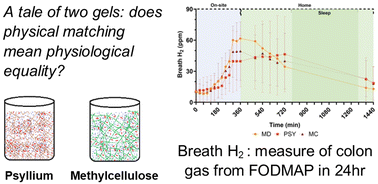
Dietary fibre is vital for a healthy diet, yet many people avoid it because of symptoms induced by colonic gas. Slowing rapid fermentation decreases colonic distention and reduces symptoms, allowing for better tolerance of prebiotics. Co-administration of inulin, a fermentable fibre, with psyllium, a gel-forming fibre, reduces gas production in irritable bowel syndrome patients compared to administering inulin alone, but the underlying mechanism is unclear. We hypothesise that psyllium polysaccharides’ physically cross-linked gel resists gastrointestinal shear forces and impairs microbial access to inulin, thereby delaying fermentation. Methylcellulose is another physically cross-linked fibre ingredient, widely used in food production for its tunability and affordability. Our aim was to develop a preparation of methylcellulose of comparable functionality to psyllium. A formulation of methylcellulose with comparable rheological and inulin release behaviour was developed in vitro. We subsequently performed a randomised, three-way, placebo-controlled non-inferiority study with healthy volunteers (n = 30), comparing the slowing of fermentation of inulin by co-administering with psyllium, methylcellulose or a control maltodextrin. Fermentation in vivo was assessed by breath hydrogen measurements for 24 hours after ingestion. While psyllium significantly reduced initial breath hydrogen production compared to the placebo, a non-inferior effect on reduction in initial breath hydrogen with methylcellulose was not demonstrated. Despite similar physicochemical properties, psyllium and methylcellulose hydrogels exhibited different transit behaviour based on the breath hydrogen time to rise >10 ppm and time to peak. We hypothesise that the fast reformation of psyllium's polysaccharide network or “self-healing” properties after deformation by intestinal pressure waves may underpin its effectiveness in slowing fermentation. The clinical trial registry number is NCT05911347 (https://clinicaltrials.gov).
- This article is part of the themed collection: Food & Function HOT Articles 2026
 Please wait while we load your content...


