


 PLATFORM UPDATE:


Rational design of a dummy-imprinted nanoplatform for ultrasensitive and leakage-free headspace-electrochemical detection of 2-MIB

Abstract
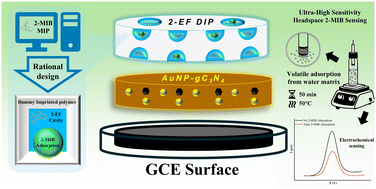
The accumulation of taste and odor (T&O) metabolites, particularly 2-methylisoborneol (2-MIB), poses persistent challenges to drinking water security. Conventional reliance on centralized chromatography creates logistical bottlenecks that impede real-time decision-making. Herein, we report an integrated headspace-electrochemical nanoplatform (IHEN) utilizing a high-fidelity “dummy” template strategy for rapid on-site detection. Guided by a multi-scale computational screening protocol involving topological similarity analysis and density functional theory (DFT) calculations, 2-ethylfenchol (2-EF) was rationally selected as a cost-effective, isostructural analog to create precise recognition cavities. This approach significantly enhances analytical fidelity by distinguishing signal responses from potential template residues, while the integrated headspace configuration ensures a physically leakage-free detection process that protects the original sample matrix from secondary contamination. The sensing interface integrates a dummy-imprinted polymer with a gold nanoparticle (AuNP) and graphitic carbon nitride (g-C3N4) nanocomposite scaffold, which synergistically amplifies electron transfer kinetics and vapor-phase capture efficiency. The resulting sensor achieves an ultralow limit of detection (LOD) of ∼96 pg L−1, far surpassing human sensory thresholds. Validated by excellent recovery in natural waters, this portable, cost-effective paradigm enables decentralized monitoring for the proactive management of T&O events in water treatment facilities.
 Please wait while we load your content...


