


 PLATFORM UPDATE:


Stable carbon-encapsulated nano zero-valent cobalt catalyst for ultrafast elimination of emerging contaminants in water

Abstract
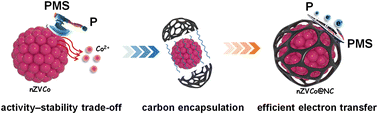
The development of highly efficient and stable cobalt-based catalysts is a critical challenge in advanced oxidation processes (AOPs) for the removal of emerging contaminants from aquatic environments. In this study, we designed a carbon-encapsulated nanoscale zero-valent cobalt catalyst (nZVCo@NC), where the protective carbon shell minimizes cobalt loss by preventing direct interaction with aqueous species. Simultaneously, the inner cobalt core modulates the electronic structure of the nitrogen-doped carbon shell, facilitating enhanced PMS activation. This design enables nZVCo@NC to serve as a rapid electron-transfer conduit between organic pollutants and peroxymonosulfate, achieving fast degradation within 2 min and reaching ∼80% mineralization efficiency in just 10 min. The catalyst also exhibits excellent resistance to interference from various inorganic ions and complex water matrices, with long-term stability validated in continuous-flow systems. This work provides a practical and scalable approach for leveraging the high catalytic potential of transition metals while mitigating toxicity concerns through carbon encapsulation.
 Please wait while we load your content...


