


 PLATFORM UPDATE:


Unraveling the interfacial fate of nanoplastics in soil: proteomics and molecular dynamics decipher the protein corona governed by surface functionalization
 *a
and
*a
and
Abstract
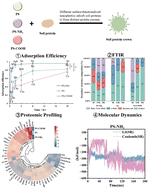
Interactions between nanoplastics and soil proteins can profoundly influence their environmental behavior and transformation in terrestrial environments. Here, experimental characterisation combined with molecular dynamics simulations was employed to elucidate the mechanisms governing the interactions between soil proteins and nanoplastics with different surface functionalities. All three nanoplastics adsorbed soil proteins to form distinct protein coronas. Amino-modified nanoplastics formed more complex and stable coronas primarily through electrostatic interactions, whereas unmodified and carboxyl-modified particles exhibited weaker adsorption driven by hydrophobic interactions. Spectroscopic analyses revealed protein conformational rearrangements upon adsorption, while proteomic profiling indicated enrichment of proteins related to microbial metabolism and environmental adaptation. Molecular dynamics simulations further confirmed strong and stable binding between amino-modified nanoplastics and the representative soil protein elongation factor Tu (EF-Tu), dominated by electrostatic forces. These findings provide molecular-level insights into how surface modification modulates nanoplastic–protein interactions in soil-relevant systems.
 Please wait while we load your content...


