


 PLATFORM UPDATE:


Reprogramming of black bean leaf metabolism by zinc nanofertilizers and biofertilizers revealed through NMR metabolomics

Abstract
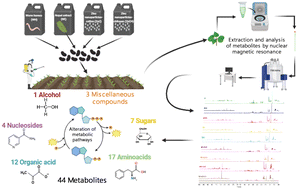
Zinc (Zn) is one of the essential micronutrients required for plant growth. The objective of this work was to evaluate the effect of two Zn oxide nanoparticles (NPs) as nanofertilizers (NFs): cotton-synthesized Zn NPs (ZnC) and chitosan-synthesized Zn NPs (ZnCh), and two biofertilizers (BFs): nopal cactus extract (NE) and commercial lumbrihumus Biojal® (WH), and the combination of both, as well as a control (water), on the growth and metabolomic profile of black bean seedlings. Leaf application of ZnC, NE + ZnCh and WH increased plant height (35.9%, 35.5%, and 25.7%) and the number of leaves (38.4%, 39.3%, and 36.9%). Metabolic profiling analysis obtained by NMR identified 44 metabolites: 7 sugars, 17 amino acids, 12 organic acids, 4 nucleosides, 1 alcohol (methanol) and 3 miscellaneous compounds (trigonelline, choline, and NAD+). WH + ZnC treatment increased the concentration of organic acids such as 3-O-caffeoylquinic acid (5%), 5-O-caffeoylquinic acid (152.6%), fumaric acid (292.3%), and pyruvic acid (150.0%), amino acids such as methionine (177.8%), leucine (241.9%), histidine (233.3%), aspartate (79.6%), and alanine (127.4%), and nucleosides such as uridine and cytidine (156.3% and 266.7%). Metabolic pathway analysis predicted 11 altered metabolic pathways mainly affecting amino acids, sugars, and organic acids. From the above, it is assumed that the use of Zn as NFs, as well as the combination of NFs + BFs, can improve growth and enhance the accumulation of metabolites by acting synergistically, which could help improve the quantitative and qualitative development of the crop.
 Please wait while we load your content...


