


 PLATFORM UPDATE:


Beyond single nanomaterial exposure: investigating the fate of a TiO2 and CeO2 nanomaterial mixture in freshwater mesocosms

Abstract
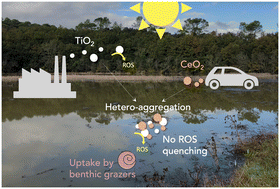
Assessing the environmental risks of emerging contaminants related to new technologies remains a major challenge due to the diversity of pollutants, their complex interactions, and the limitations of conventional testing frameworks. Among these contaminants, engineered nanomaterials (ENMs) stand out for their unique surface reactivities and transformation pathways, which can significantly alter their behavior and that of co-occurring pollutants. Although many studies have addressed the toxicity and fate of individual ENMs, real-world scenarios often involve complex mixtures, whose combined effects are less investigated. This study addresses this gap by investigating the fate, behavior, and ecological impacts of a mixture of two representative metal oxide ENMs i.e. an industrial TiO2 and a combustion-derived CeO2. This study shows that under environmentally relevant conditions using freshwater mesocosms, these two ENMs undergo primary hetero-aggregation. Co-exposure of the freshwater snail Planorbarius corneus revealed that ENM aggregates (homo- or primary hetero-aggregates) interact with egg layings, potentially affecting early developmental stages, while slight but measurable uptakes were also observed in co-exposed adult snails. Importantly, no quenching of reactive oxygen species generated by the photocatalytic TiO2 was detected in the presence of CeO2, suggesting that the combusted CeO2 does not mitigate potentially TiO2-induced phototoxicity. These findings underscore the importance of considering ENM mixtures in environmental risk assessments and the relevance of mesocosm experiments to capture realistic exposure scenarios. Future studies should prioritize investigating how unique surface reactivities and transformation mechanisms of ENM mixtures shape their ecological impacts throughout their life cycles.
 Please wait while we load your content...


