


 PLATFORM UPDATE:

Iron-oxide nanoparticle release from jellyfish-based hydrogels for agricultural fertilization
 a
Ines
Zucker
*a
a
Ines
Zucker
*a
Abstract
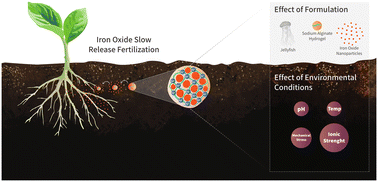
Iron (Fe) is an essential nutrient for plant growth, yet its bio-availability in soil is often restricted, limiting crop productivity. Conventional iron fertilizers, such as iron salts and chelates, suffer from inefficiencies and contribute to environmental concerns, including leaching and soil acidification. This study explores the use of jellyfish-based hydrogels as a slow-release carrier for iron-oxide nanoparticles (Fe-NPs) to enhance iron bio-availability in agricultural soils. Jellyfish-derived biomaterials offer a sustainable and biodegradable matrix with high water retention and tunable gel properties, making them an effective medium for controlled nutrient release. In this study, iron release was examined across various hydrogel formulations and environmental conditions to assess factors influencing nutrient bio-availability. The results demonstrate that iron release is highly dependent on hydrogel formulation, with key factors including hydrogel strength and the method of iron loading, such as nanoparticle selection and cross-linking with iron ions. Hydrogels cross-linked with iron ions released iron more rapidly than those cross-linked with calcium, while Fe3O4-containing hydrogels exhibited faster release than those incorporating Fe(OH)3 nanoparticles. Additionally, monovalent ions accelerated hydrogel degradation through ion exchange, leading to increased iron release. Soil suspension experiments further confirmed that monovalent ions are a primary driver of hydrogel breakdown and iron release, whereas microbial activity has minimal impact on iron release. These findings highlight jellyfish-based hydrogels as an effective and biodegradable slow-release system, capable of modulating iron bio-availability based on environmental and soil conditions. This approach offers a promising, sustainable alternative to conventional iron fertilizers.
- This article is part of the themed collection: Recent Open Access Articles - Environmental Science: Nano
 Please wait while we load your content...


