


 PLATFORM UPDATE:


Scalable deposition and drying methods toward large-area monolithic perovskite/silicon tandem solar cells
 *ab
*ab
Abstract
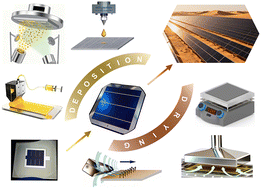
Monolithic perovskite/silicon tandem solar cells have emerged as a compelling route, combining the certified power conversion efficiencies exceeding 34% for laboratory-scale devices with more cost-effective manufacturing compared to market-established silicon photovoltaics. Despite deployment in pilot processing lines beyond the lab stage, this technology still faces scaling challenges from perovskite sub-cells, such as the incompatibility with contemporary mass production lines and the upscaling efficiency deficit, that are expected to be resolved within a few years to achieve commercial viability. Here, we comprehensively elaborate the scalable deposition and drying methods of perovskite sub-cells on silicon substrates and review their recent advanced progress. We assess the merits and limitations of these competing methods, providing a systematic framework for achieving efficient and durable large-area perovskite/silicon tandem solar cells suitable for industrial production.
- This article is part of the themed collections: Celebrating Nam-Gyu Park’s 65th birthday and Energy & Environmental Science 2026 Review Articles
 Please wait while we load your content...


