


 PLATFORM UPDATE:


Nanotwin engineering enables exceptional thermal stability in p-type bismuth telluride thermoelectrics

Abstract
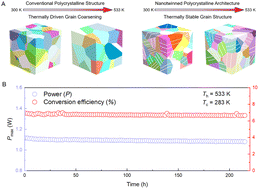
Thermal stability is a critical challenge limiting the practical deployment of thermoelectric materials in real-world energy conversion. This study presents a breakthrough by incorporating dense nanoscale twin boundaries into bismuth telluride-based thermoelectrics, achieving concurrent improvements in thermoelectric efficiency, mechanical robustness, and operational longevity. The coherent twin interfaces, characterized by their crystallographic symmetry and minimal electron scattering, effectively reduce lattice thermal conductivity while preserving charge carrier mobility. Remarkably, the material maintains a high power factor and a low thermal conductivity even after extended thermal aging. Device-level testing confirms exceptional stability, with twin-engineered devices retaining >98% of their output power and conversion efficiency across repeated thermal cycles, alongside intact interfacial contacts and no observable microstructural degradation. These results highlight nanotwin boundary engineering as a robust microstructural design paradigm for developing high-performance, durable thermoelectric device applications.
 Please wait while we load your content...


