


 PLATFORM UPDATE:


Novel bismuth–selone molecular precursor based selective synthesis of Bi2Se3 nanoplates and nanosheets: a promising electrocatalyst for hydrogen evolution in a neutral medium
 cd
Jitendra
Bahadur,
e
Gourab
Karmakar,
*cd
Rohit Singh
Chauhan
*a
and
Adish
Tyagi
*cd
cd
Jitendra
Bahadur,
e
Gourab
Karmakar,
*cd
Rohit Singh
Chauhan
*a
and
Adish
Tyagi
*cd
Abstract
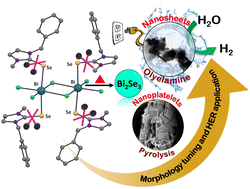
Designing molecular precursors for the controlled synthesis of functional nanomaterials holds immense promise for advancing sustainable energy technologies. Herein, we report the synthesis and structural characterization of an air-stable bismuth(III) complex, [(L)2BiCl2(μ-Cl)]2 (1), derived from 3-benzyl-1-methyl-(1H)-imidazole-2(3H)-selone (L). This complex serves as an efficient single-source molecular precursor (SSP) for the facile preparation of rhombohedral Bi2Se3 nanostructures under mild conditions. A plausible mechanism behind the facile decomposition of the molecular complex into Bi2Se3 materials has been discussed. Powder X-ray diffraction (PXRD), electron microscopy, and diffuse reflectance spectroscopy (DRS) confirm the phase purity, crystal structure, and optical properties of the nanomaterials. Notably, reaction conditions significantly influenced the morphology, yielding nanoplates under solventless decomposition and nanosheets under solvent-assisted thermolysis. These Bi2Se3 nanostructures exhibit optical bandgaps of ∼1.56 eV (nanoplates) and ∼1.60 eV (nanosheets), highlighting their potential in optoelectronic and catalytic applications. Notably, the Bi2Se3 nanoplates demonstrate excellent HER performance, achieving an overpotential of 372 mV at −10 mA cm−2, a Tafel slope of ∼62 mV dec−1, and robust stability over 2000 cycles and 18 hours of continuous operation. Density functional theory (DFT) calculations reveal surface charge heterogeneity at the exposed Bi2Se3 layers, which is expected to enhance the adsorption of polar species. This study highlights the significance of the molecular precursor strategy for controlled synthesis of efficient Bi2Se3-based electrocatalysts for sustainable hydrogen production in neutral aqueous environments.
 Please wait while we load your content...


