


 PLATFORM UPDATE:


Frontiers in circularly polarized photoluminescence and electroluminescence of chiral manganese(ii) complexes
 a
and
You-Xuan
Zheng
*b
a
and
You-Xuan
Zheng
*b
Abstract
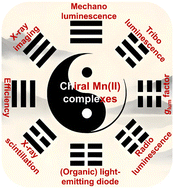
Chiral luminescence materials and their application in biological sensors, mechanoluminescence, triboluminescence, radioluminescence, X-ray scintillation, and circularly polarized organic light-emitting diodes have attracted widespread attention due to their circularly polarized luminescence properties. Among the chiral luminescence materials, phosphorescent complexes with noble metals have been widely investigated, benefiting from their ability to harvest both singlet and triplet excitons in devices. However, although phosphorescent manganese(II) complexes are highly cost-effective and exhibit good luminescence properties and low toxicity, the development of chiral Mn(II) complexes has been slow. This review mainly focuses on the molecular design strategies, photophysical and chiroptical properties, and applications of chiral Mn(II) complexes in different fields while discussing recent progress, challenges and outlook in this area.
- This article is part of the themed collection: 2026 Frontier and Perspective articles
 Please wait while we load your content...


