


 PLATFORM UPDATE:

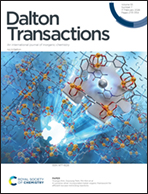
Sub lattice driven spin state ordering and coordination elasticity in Fe(ii) 1,3,4-thiadiazole complexes
 a
Sriram
Sundaresan,
ab
Tim
Hochdörffer,
c
Juliusz A.
Wolny,
c
Luca M.
Carrella,
a
Volker
Schünemann
c
and
Eva
Rentschler
*a
a
Sriram
Sundaresan,
ab
Tim
Hochdörffer,
c
Juliusz A.
Wolny,
c
Luca M.
Carrella,
a
Volker
Schünemann
c
and
Eva
Rentschler
*a
Abstract
Understanding the role of co-ligand identity, governing spin-state energetics in many Fe(II) complexes, is essential for designing responsive spin-crossover materials. We report the synthesis of an unsymmetrical bis(pyridin-2-ylmethyl)glycyl benzohydrazide-derived ligand, 1-(5-phenyl-1,3,4-thiadiazol-2-yl)-N,N-bis(pyridin-2-ylmethyl)methanamine (LPh-TDA), and its corresponding complexes [Fe(LPh-TDA)(NCE)2]·H2O (E = S (C1), Se (C2), BH3 (C3)). While the ligand-field strength gradient ranges from weak (NCS−) to strong (NCBH3−), the SCO behaviour of the resulting complexes does not reflect this. Variable-temperature single-crystal X-ray diffraction, SQUID magnetometry and 57Fe Mössbauer spectroscopy show that there is packing-induced sublattice spin-state ordering for C1, which has two distinct Fe(II) sites. Of these sites, only one transitions to the low-spin state in two complexes, while the second remains locked in the high-spin (HS) state. C2 remains high-spin throughout the entire temperature range, whereas C3 exhibits a complete, one-step SCO with T1/2 = 153 K. Density functional theory (DFT) calculations help to quantify the energetic origin of the ordered LS–HS configuration in C1 and demonstrate that intermolecular packing effects override intrinsic ligand-field trends. These results highlight the dominant role of solid-state organization in dictating SCO behavior, even in systems engineered to isolate co-ligand electronic effects.

- This article is part of the themed collection: Articles behind our 2026 journal covers
 Please wait while we load your content...


