


 PLATFORM UPDATE:


Silver(i) complexes with N-methylphenothiazine as potential antimicrobial agents with a multi-target mode of action
 a
Jovica
Branković,
a
Tatjana
Ilic-Tomic,
b
Nevena
Stevanović,
a
Bojana
Pantović,
a
Darko P.
Ašanin,
c
Jasmina
Nikodinovic-Runic,
b
Vladimir P.
Petrović,
a
Violeta R.
Marković
*a
and
Biljana Đ.
Glišić
*a
a
Jovica
Branković,
a
Tatjana
Ilic-Tomic,
b
Nevena
Stevanović,
a
Bojana
Pantović,
a
Darko P.
Ašanin,
c
Jasmina
Nikodinovic-Runic,
b
Vladimir P.
Petrović,
a
Violeta R.
Marković
*a
and
Biljana Đ.
Glišić
*a
Abstract
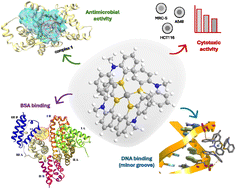
N-Methylphenothiazine (N-Mephtz) was used as a ligand for the synthesis of three new silver(I) complexes with the general formula [Ag(N-Mephtz)4]X·nH2O (X is CF3SO3− and n = 1/3 for 1, X is SbF6− and n = 0 for 2, and X is PF6− and n = 0 for 3). These complexes were characterized using spectroscopic methods, while their structures were determined by single crystal X-ray diffraction analysis. In all complexes, four N-Mephtz ligands are monodentately coordinated to the silver(I) ion through the sulfur atom, forming cationic [Ag(N-Mephtz)4]+ species, with CF3SO3−, SbF6− and PF6− acting as counterions for 1–3, respectively. Experimental IR band assignments were supported by DFT calculations, and TD-DFT simulations provided insight into their UV-Vis spectra. The antimicrobial activity of complexes 1–3 was evaluated against different bacterial strains and one fungal strain, with complex 1 exhibiting notable activity against all tested microorganisms, with MIC values ranging from 8 to 30 µg mL−1 (7.17 to 26.88 µM). Molecular docking screening identified eight potential antimicrobial protein targets among the tested microorganisms. Cytotoxicity assessments revealed pronounced effects on human lung cancer (A549) and colon cancer (HCT116) cell lines, suggesting potential antiproliferative activity. However, the observed cytotoxicity toward mammalian cells also indicates the need for further structural refinement to improve selectivity for antimicrobial applications. The interactions of the complexes with calf thymus DNA (ct-DNA) and bovine serum albumin (BSA) were examined to assess their biomolecular binding affinities. The binding constant (KA) indicated that complexes 1 and 3 have a similar binding affinity to this protein as N-Mephtz, while complex 2 demonstrated a lower affinity. All complexes exhibited significantly enhanced ct-DNA binding via the minor groove compared to the free ligand. Molecular docking confirmed strong minor groove DNA interactions and identified favorable BSA binding sites.
 Please wait while we load your content...


