


 PLATFORM UPDATE:


Dynamic reconstructing sulfur vacancies-rich Ni3S2 interfaces for highly selective silane–alcohol dehydrogenation coupling
 *a
and
Chao
Chen
a
*a
and
Chao
Chen
a
Abstract
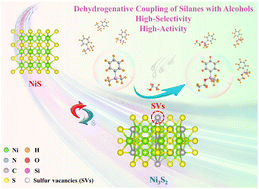
As a key functional molecule in the organosilicon industry, the green synthesis of silyl ethers is crucial for materials science and pharmaceutical manufacturing. To address the dual bottlenecks of traditional alcoholysis processes (highly corrosive feedstocks/harmful byproducts) and existing catalysts (high precious metal costs and low non-precious metal efficiency), this study innovatively employs sulfur-containing porous organic polymers (POPs) combined with interfacial engineering strategies. Through precise control of pyrolysis and in situ nickel salt impregnation, a nickel–sulfur species/heteroatom-doped porous carbon composite catalyst with abundant active interfaces was successfully constructed. Its high-performance catalytic mechanism stems from two key aspects: (1) interfacial electronic structure modulation – heteratom-doped carbon supports optimize the d-band centers of nickel species through electronic induction effects; and (2) interfacial defect dynamic construction – the NiS → Ni3S2 phase transition induces high-density sulfur vacancies (SVs) in the interfacial region, significantly enhancing substrate adsorption and activation capabilities. Leveraging the synergistic catalysis of this multifunctional interface, the silane–alcohol dehydrogenation coupling reaction achieves 99% conversion and 99% selectivity. This work establishes a novel “multifunctional interface synergistic catalysis” paradigm integrating electronic modulation, structural evolution, and defect engineering, providing theoretical support and practical solutions for economically sustainable organosilicon synthesis technologies.
 Please wait while we load your content...


