


 PLATFORM UPDATE:

Interface enhancement through electrostatic self-assembly for synergistically stabilized silicon anodes in lithium-ion batteries
 a
Haiqun
Chen
*a
a
Haiqun
Chen
*a
Abstract
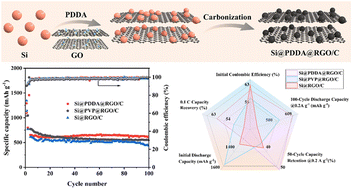
Due to its high theoretical specific capacity and abundant natural reserves, silicon (Si) is regarded as one of the most promising candidates for the next generation of lithium-ion batteries (LIBs). However, the poor conductivity and significant volume expansion of Si during the lithiation/delithiation process seriously hinder the commercialization of Si anodes for LIBs. Herein, poly(diallyldimethylammonium chloride) (PDDA) was introduced to modify the surface charge of Si nanoparticles (NPs) and then encapsulated them with a graphene framework, followed by covering them with a carbon layer to form a Si–C composite (Si@PDDA@RGO/C). In particular, pyrolytic carbon not only mitigates the large volume change of Si but also ensures good contact with graphene, thereby preserving the structural integrity of the electrode during cycling. The flexible lamellar structure of graphene provides ample space for the dispersion of Si NPs, improving the conductivity of the composite while also suppressing the volume change of Si. The results demonstrate that the double-layer carbon-coated Si NPs improve the cycling stability of the anode material with an initial charge/discharge capacity of 783.48/1292.24 mAh g−1, a coulombic efficiency of 60.63%, and a discharge capacity of approximately 620.13 mAh g−1 after 100 cycles at 0.2 A g−1, as well as excellent rate performance and electrochemical reaction kinetics.
 Please wait while we load your content...


