


 PLATFORM UPDATE:

Bilayer inorganic/organic metakaolin/polyethylene glycol-coated magnetite nanoparticles: MRI transverse relaxivity, cytocompatibility, and 5-fluorouracil release behavior

Abstract
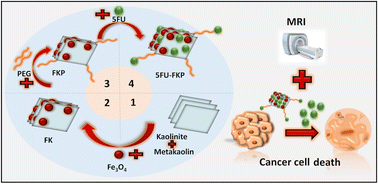
Novel bifunctional nanosystems consisting of magnetic resonance imaging (MRI) nanocontrast agents and chemotherapeutic drugs have potential for detecting and treating cancers. In this study, magnetite nanoparticles were coated with an inorganic/organic (metakaolin/polyethylene glycol (PEG)) compound to prepare a bilayer nanocomposite (FKP). The nanocomposite was loaded with 5-fluorouracil (5FU) to investigate 5FU-FKP transverse relaxivity for MRI contrast enhancement and in vitro 5FU loading/release. X-ray diffraction (XRD), Fourier transform infrared spectroscopy (FT-IR), transmission electron microscopy (TEM), vibrating sample magnetometry (VSM), and thermogravimetric analyses (TGA) were used to determine the physicochemical characteristics of the nanocomposite. Cytotoxicity was investigated by the MTT assay. The 5FU loading and release studies demonstrated a high drug loading efficiency (97.4%) and sustained pH-dependent drug release of 81.3% and 91.7% at pH of 7.4 and 5.0 after 96 h, respectively. The superparamagnetic 5FU-FKP nanocomposite indicated high transverse relaxivity (r2 = 558.4 mM−1 s−1) as a negative contrast agent of MRI. The MTT evaluation revealed the cytocompatibility of the surface-coated Fe3O4 nanoparticles (FKP nanocomposite) and the higher cytotoxicity of 5FU-FKP compared to free 5FU. Therefore, the 5FU-FKP nanocomposite can be considered a potential candidate for MRI and 5FU delivery.
 Please wait while we load your content...


