


 PLATFORM UPDATE:


Ruthenium complex bearing pyrrolbipyridine and dimethyl sulfoxide ligands: syntheses, structures, substitution reactions, and catalytic ammonia oxidation behavior
 a
and
Xiao-Yi
Yi
*a
a
and
Xiao-Yi
Yi
*a
Abstract
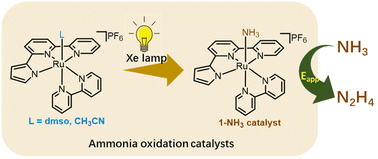
Treatment of cis-[Ru(dmso)4Cl2], bipy and Hpbp (dmso = dimethyl sulfoxide, bipy = 2,2′-bipyridine, Hpbp = 6-(1H-pyrrol-2-yl)-2,2′-bipyridine) in the presence of Et3N affords the ruthenium complex [Ru(pbp)(bipy)(dmso)]PF6 (1). This complex demonstrates the S → O linkage isomerization of the dmso ligand upon Ru-center oxidation from +II to +III, as confirmed by thermodynamic and kinetic data obtained from cyclic voltammetry (CV) experiments. The photochemical S → O linkage isomerization of the dmso ligand in complex 1 is also observed. Taking advantage of the photoinduced linkage isomerization in complex 1, complexes [Ru(pbp)(bipy)(CH3CN)]PF6 (1-CH3CN) and [Ru(pbp)(bipy)(NH3)]PF6 (1-NH3) are synthesized with high yield upon irradiation of the DMSO ligand of complex 1 in the presence of CH3CN and NH3, respectively. These complexes are fully characterized via NMR, IR, EA, ESI-MS, and EA. X-ray diffraction analysis revealed that the CH3CN and NH3 ligands in 1-CH3CN and 1-NH3 in place of the dmso ligand in complex 1 coordinate with the Ru center at the axial position. Complex 1-NH3 demonstrates good electrocatalytic performance for the selective oxidation of ammonia to hydrazine.
 Please wait while we load your content...


