


 PLATFORM UPDATE:


HfS2/GeSe heterostructure engineering for superior photocatalytic hydrogen generation: design, mechanism, and efficiency
 *ab
*ab
Abstract
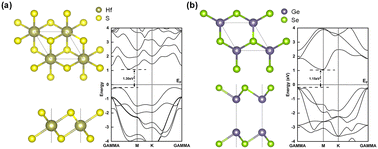
In this study, HfS2/GeSe heterostructures are constructed to address the issues of high carrier recombination and narrow light absorption in monolayer HfS2 for photocatalysis. DFT and AIMD calculations reveal stacking-I as the most stable structure, in which electron transfer from HfS2 to GeSe forms a 2.86 eV built-in electric field, enhancing photogenerated carrier separation. The HER and OER occur in the GeSe and HfS2 layers, respectively, enabling overall water splitting. The heterojunction shows a high hole mobility (5148.61 cm2 V−1 S−1 along the y-direction) and a theoretical STH efficiency of 24.63%. Gibbs free energy analysis indicates that the photogenerated carriers provide 0.39 eV (HER) and 0.62 eV (OER) overpotentials, requiring minimal external voltage at pH = 0. This work theoretically demonstrates the potential of the HfS2/GeSe heterojunction for efficient photocatalysis, offering a new direction for clean energy material design.
 Please wait while we load your content...


