


 PLATFORM UPDATE:


Hydrogel-integrated systems for solar hydrogen production: mechanistic insights and future prospects
 *a
*a
Abstract
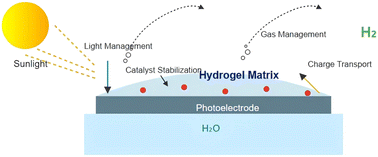
Hydrogels, as water-rich, flexible, and chemically tunable materials, stand out as exceptionally promising scaffolds for advancing solar hydrogen production, encompassing both photocatalytic (PC) and photoelectrochemical (PEC) systems. This review delves into recent progress in hydrogel-integrated solar hydrogen platforms, placing particular emphasis on PEC configurations where interfacial charge transport, ionic conduction, and electrode coupling prove critically important. We analyze the fundamental mechanisms governing hydrogel–photoelectrode interfaces, elucidate innovative design strategies for catalyst confinement and redox modulation, and rigorously compare hydrogel systems with alternative catalyst immobilization and soft-material platforms. Beyond fundamental research, we highlight compelling real-world application scenarios, including seawater splitting and flexible devices, while critically addressing key challenges related to environmental stability, catalyst leaching, performance standardization, and scalability. Finally, we discuss future perspectives, spotlighting crucial directions spanning materials-level benchmarking, intelligent functionality, interfacial regulation, environmental resilience, scalability, system integration, life-cycle sustainability, photothermal coupling, atmospheric water harvesting strategies, and standardized testing.
 Please wait while we load your content...


