


 PLATFORM UPDATE:


MACE foundation models for lattice dynamics: a benchmark study on double halide perovskites

Abstract
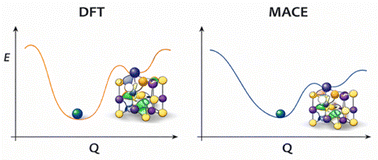
Recent developments in materials informatics and artificial intelligence have led to the emergence of foundational energy models for material chemistry, as represented by the suite of MACE-based foundation models, bringing a significant breakthrough in universal potentials for inorganic solids. As to all method developments in computational materials science, performance benchmarking against existing high-level data with a focus on specific applications, is critically needed to understand the limitations in the models, thus facilitating the ongoing improvements in the model development process, and occasionally, leading to significant conceptual leaps in materials theory. Here, using our own published DFT (density functional theory) database of room-temperature dynamic stability and vibrational anharmonicity for ∼2000 cubic halide double perovskites, we benchmarked the performances of four different variants of the MACE foundation models for screening the dynamic stabilities of inorganic solids. Our analysis shows that, as anticipated, the model accuracy improves with more training data. The dynamic stabilities of weakly anharmonic materials (as predicted by DFT) are more accurately reproduced by the foundation model, than those of highly anharmonic and dynamically unstable ones. The predominant source of error in predicting dynamic stability arises from the amplification of errors in atomic forces when predicting the harmonic phonon properties through the computation of the Hessian matrix, less so is the contribution from possible differences in the range of the configurational spaces that are sampled by DFT and the foundation model in molecular dynamics. We hope that our present findings will stimulate future studies towards more physics-inspired approaches in assessing the accuracy of foundation models for atomistic modelling.
- This article is part of the themed collection: 2026 PCCP HOT Articles
 Please wait while we load your content...


