


 PLATFORM UPDATE:


Impact of halogen axial coordination on the electronic and magnetic properties of MN4 single-atom catalysts for oxygen reduction
 *a
*a
Abstract
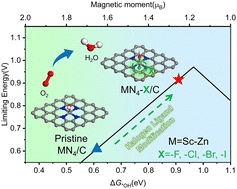
The rational design of single-atom catalysts (SACs) through coordination engineering is a pivotal strategy for enhancing the oxygen reduction reaction (ORR). While axial ligand coordination has been identified as a promising approach, the specific role of halogen atoms and their influence on both electronic and magnetic properties remain insufficiently explored. Herein, we present a systematic first-principles study on the impact of axial halogen ligands (X = –F, –Cl, –Br, –I) on the ORR performance of MN4/C SACs across the 3d transition metal series. Our computations reveal that halogen coordination universally enhances the structural stability of the single-atom sites and, in most cases, significantly improves the ORR activity. Among the studied metals, iron-based catalysts exhibit the most pronounced promotion, which we attribute to the competitive coordination between the halogen and reaction intermediates for the Fe dz2 orbital, leading to an optimized adsorption strength of oxygenated species. Crucially, we identify a robust linear correlation between the metal-centered magnetic moment and the adsorption free energy of key intermediates. This relationship establishes the magnetic moment as a novel and effective descriptor for predicting ORR activity, providing a fresh perspective for catalyst design. These findings underscore the role of axial halogen ligands in modulating electronic and magnetic properties, offering a viable pathway for developing high-performance M–N–C electrocatalysts.
 Please wait while we load your content...


