


 PLATFORM UPDATE:


Yttrium-doped lithium and potassium clusters: magnetic superatoms and their interaction with hydrogen
 *a
Zeferino
Gómez-Sandoval,
*a
Gururaj
Kudur Jayaprakash,
b
Juan Pablo
Mojica-Sánchez,
c
Roberto
Flores-Moreno
de
and
Kayim
Pineda-Urbina
a
*a
Zeferino
Gómez-Sandoval,
*a
Gururaj
Kudur Jayaprakash,
b
Juan Pablo
Mojica-Sánchez,
c
Roberto
Flores-Moreno
de
and
Kayim
Pineda-Urbina
a
Abstract
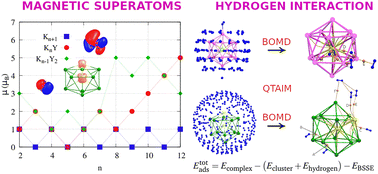
In this study, we explored the energetic, structural, and magnetic properties of yttrium-doped lithium and potassium clusters using density functional theory combined with Born–Oppenheimer molecular dynamics simulations. The analysis revealed magnetic superatoms such as K9Y2 (μ = 5μB) with a frontier configuration analogous to Fe+. Global reactivity descriptors, particularly the low hardness values (η), identified K12Y, K11Y2, and K13 as the most reactive potassium clusters, while the analogous Li12Y, Li11Y2, and Li13 were also selected for subsequent hydrogen interaction analyses. The most stable hydrogen–cluster structures extracted from Born–Oppenheimer molecular dynamics at 300 K were reoptimized including dispersion corrections to compute adsorption and Gibbs free energies. The resulting complexes were analyzed through QTAIM, ELF, and Laplacian electron density maps, complemented by CM5 charge analysis. These results reveal predominant molecular physisorption across the Y-doped systems, with localized polarized chemisorption only in Li12Y. Overall, yttrium doping enhances magnetic polarization, energetic stability, and structural resilience of alkali-metal clusters, which retain their superatomic character and near-icosahedral frameworks under hydrogen exposure.
 Please wait while we load your content...


