


 PLATFORM UPDATE:


First-principles insights into chromium-induced oxide phases in NiO

Abstract
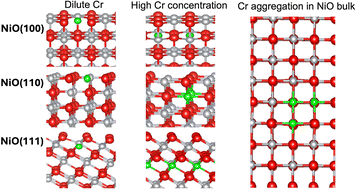
The high-temperature oxidation of Ni–Cr alloys leads to complex oxide scales comprising Ni(Cr)O solid solutions, NiCr2O4 spinel, and Cr2O3 corundum within the NiO matrix. Understanding the atomic-scale mechanisms of Cr segregation and precipitate formation is crucial for enhancing oxidation resistance. Here, we employ density functional theory calculations to investigate Cr behavior on NiO(100), (110), and (111) surfaces and in the bulk. Our results reveal that isolated Cr atoms preferentially segregate to the surfaces, stabilizing Ni(Cr)O solid solutions via strong Cr–O bonding, whereas Cr pairs and clusters favor subsurface migration and bulk aggregation, promoting nucleation of NiCr2O4 and Cr2O3 phases. These findings elucidate a size-dependent segregation mechanism linking Cr coordination environments to oxide phase evolution. This atomic-scale insight informs strategies to tailor oxide microstructures and enhance the high-temperature oxidation resistance of Ni–Cr alloys.
 Please wait while we load your content...


