


 PLATFORM UPDATE:


Designing in situ nanostructured MWCNT-phloroglucinol modified webs for electrochemical-based dual screening of stress biomarkers
 a
and
Anitha
Varghese
*a
a
and
Anitha
Varghese
*a
Abstract
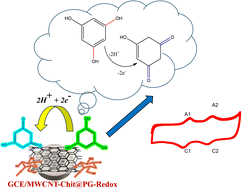
Phloroglucinol (PG), or benzene 1,3,5-triol, is an essential phenolic compound and a vital tannin. In this study, we developed a tannin-phloroglucinol (PG) derived redox mediator for the detection of glutathione (GT) and H2O2 on a glassy carbon electrode (GCE) modified with a multiwalled-chitosan composite. The PG redox platform was prepared using a cyclic voltammetric approach in pH 7 aqueous buffer media without any additional surfactant/chemical moieties. A highly stable, fouling-free surface confined redox characteristic was observed at an apparent electrode potential of E0′ = −0.196 V (A1/C1) and 0.05 V (A2/C2) vs. Ag/AgCl was observed. The as-prepared electrochemical platform achieved an ultra-low limit of detection (LOD) for glutathione (GT) of 0.16 µM and LOQ of 2.08 µM using a sustainable platform. In addition, it exhibited high selectivity for GT in the presence of various interfering analytes. In addition, the modified platform was extended to hydrogen peroxide (H2O2) sensing at −0.196 V vs. Ag/AgCl with a LOD of 5.4 µM in PBS buffer media at v = 10 mV s−1. The GCE/MWCNT-Chit@PG-Redox demonstrated robust performance in a proof-of-concept experiment for analyzing GT and H2O2 in real samples using a standard addition approach with good recovery values.
 Please wait while we load your content...


