


 PLATFORM UPDATE:


Time-dependent solvothermal synthesis of melamine cyanurate and melamine diborate: experimental and theoretical insights

Abstract
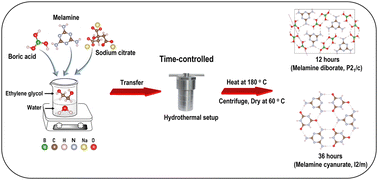
This study introduces a time-dependent solvothermal synthesis of hydrogen-bonded melamine cyanurate and melamine diborate at 180 °C, offering precise control over their framework compositions and structures through reaction time. The selective formation of melamine diborate and melamine cyanurate is achieved using the same set of precursors with cyanuric acid generated in situ from melamine hydrolysis. The phase composition varies with the reaction time, as confirmed by Fourier transformed infrared (FTIR) and X-ray photoelectron spectroscopy (XPS), which reveal the structural progression of these frameworks. Our synthesis method allows melamine cyanurate to nucleate or grow on melamine diborate crystals adopting a more crystalline rod-like morphology with clearer texture. Density functional theory (DFT) enhances the understanding of their electronic structures, highlighting core-level binding energy shifts (N 1s and B 1s) and the chemical activity of lone pair electrons, with the mixture of π and σ bonds playing a key role in determining the bandgaps. This proposed synthesis method enables precise tuning of hydrogen-bonded framework compositions providing valuable insights for material synthesis and structural design.
 Please wait while we load your content...


