


 PLATFORM UPDATE:


Construction of a α-Bi2O3/α-Bi2O3 homojunction for highly efficient photocatalytic reduction of chromium(vi)
 a
Yin
Peng
*c
a
Yin
Peng
*c
Abstract
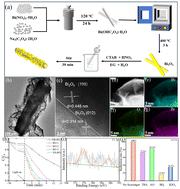
A α-Bi2O3/α-Bi2O3 homojunction composed of α-Bi2O3 nanosheets growing on α-Bi2O3 nanorods is developed by a facile room-temperature preparation method; this homojunction exhibits significantly high photocatalytic performance for reducing the heavy metal Cr(VI). The degradation of a 50 mg L–1 Cr(VI) solution under simulated sunlight takes only 6 min, and the apparent rate constant value reaches 0.657 min−1, which is 9.5 times that achieved with the α-Bi2O3 nanorods. Photocurrent time curves, electrochemical impedance spectroscopy (EIS) and PL emission spectra prove that the formation of the α-Bi2O3/α-Bi2O3 homojunction improves the transfer and separation of photogenerated e-h pairs. The average fluorescence lifetime of the α-Bi2O3/α-Bi2O3 homojunction is 5.1998 ns, which is longer than that of pure α-Bi2O3. The results of in situ irradiated X-ray photoelectron spectroscopy (ex-XPS) and the KPFM-based surface photovoltage (SPV) prove that the photoelectrons transfer from the α-Bi2O3 nanorods to the α-Bi2O3 nanosheet via the interface in light. These findings provide a general and simple synthetic method for preparing homojunction photocatalysts, which has good potential for a broad range of applications.
- This article is part of the themed collection: Nanomaterials
 Please wait while we load your content...


