


 PLATFORM UPDATE:


Peroxosolvates of purine derivatives: structural insights into possible H2O2-purine interactions in biological systems
 a
Alexey A.
Mikhaylov,
a
Elena A.
Mel'nik,
a
Pavel A.
Egorov,
a
Ovadia
Lev,
b
Alexander G.
Medvedev
a
and
Petr V.
Prikhodchenko
*a
a
Alexey A.
Mikhaylov,
a
Elena A.
Mel'nik,
a
Pavel A.
Egorov,
a
Ovadia
Lev,
b
Alexander G.
Medvedev
a
and
Petr V.
Prikhodchenko
*a
Abstract
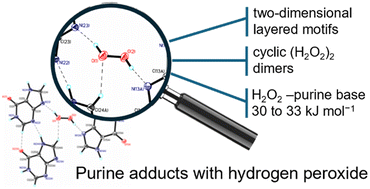
Hydrogen peroxide, a mediator of oxidative stress, promotes DNA damage. However, its direct interaction with purine derivatives was not previously studied. Five novel peroxosolvates of purine derivatives were synthesized: theophylline peroxosolvate, C7H8N4O2·H2O2 (1); theobromine peroxosolvate, C7H8N4O2·H2O2 (2); hypoxanthine peroxosolvates, 2(C5H4N4O)·H2O2 (3) and 2(C5H4N4O)·3(H2O2) (4); 6-benzylaminopurine peroxosolvate, C12H11N5·2(H2O2) (5). Their crystal structures, determined by X-ray analysis, reveal hydrogen bonding between H2O2 and the purine bases. In most structures, C–H⋯O H-bonds are significant in forming two-dimensional layered motifs. Unusual cyclic (H2O2)2 dimers were observed in two structures, with a new type of H2O2 “pendulum” disorder identified in one. Solid-state DFT calculations quantified intermolecular interaction energies: ∼35 kJ mol−1 for N–H⋯O![[double bond, length as m-dash]](https://www.rsc.org/images/entities/char_e001.gif) C, 22 kJ mol−1 for N–H⋯N, and ∼20 kJ mol−1 for C–H⋯OC contacts. The crystallographically characterized peroxosolvates provide structural insights into the non-oxidative interaction of H2O2 with purine bases. These models offer crucial benchmark data for computational studies of H2O2 adducts with purine derivatives.
C, 22 kJ mol−1 for N–H⋯N, and ∼20 kJ mol−1 for C–H⋯OC contacts. The crystallographically characterized peroxosolvates provide structural insights into the non-oxidative interaction of H2O2 with purine bases. These models offer crucial benchmark data for computational studies of H2O2 adducts with purine derivatives.
- This article is part of the themed collection: Crystal Growth
 Please wait while we load your content...


