


 PLATFORM UPDATE:


Structural diversity of supramolecular networks composed of 2,1,3-chalcogenadiazole silver(i) complexes: the role of chalcogen bonding in molecular self–assembly

Abstract
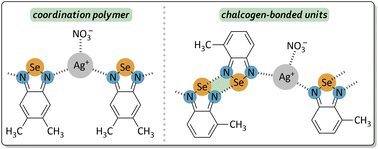
Several new coordination compounds of 2,1,3-chalcogenadiazoles with AgNO3, AgClO4, AgBF4 and AgSbF6 were prepared and structurally characterized. The observed structural diversity of the AgNO3 complexes results from a variation of the coordination mode of the NO3− unit and substitution pattern of the chalcogenadiazole ligands. Particularly the steric effect of the bulky substituent at C-4 of the chalcogenadiazole unit causes coordination to the silver cation of only one nitrogen atom, whereas the second N atom engages in [Se⋯N]2 interaction creating a 1D supramolecular polymer. The ligands without bulky substituents coordinate two silver ions from both sides of the molecule, in μ2-bridging mode, creating polymeric chain structures. In contrast, the structure of the complexes with poorly coordinating anions (ClO4−, BF4− and SbF6−) is almost not affected by substituents and in all cases each silver cation coordinates two ligand molecules, whereas the self-complementary [Se⋯N]2 interactions between the ligand molecules create 1D supramolecular polymeric structures. In some cases, solvent molecules enter the coordination sphere of the metal.
- This article is part of the themed collection: Supramolecular & Polymorphism
 Please wait while we load your content...


