


 PLATFORM UPDATE:


From solution to thin films: unravelling excited-state behaviour in halogenated diradicaloids
Roberto
Costantini,  bc
Luca
Schio,
c
Albano
Cossaro,
dc
Pasquale
Orgiani,
c
Federico
Cilento,
e
Claudia
Graiff,
f
Cristina
Tubaro,
a
Marco
Baron
*a
and
Martina
Dell’Angela
*c
bc
Luca
Schio,
c
Albano
Cossaro,
dc
Pasquale
Orgiani,
c
Federico
Cilento,
e
Claudia
Graiff,
f
Cristina
Tubaro,
a
Marco
Baron
*a
and
Martina
Dell’Angela
*c
bc
Luca
Schio,
c
Albano
Cossaro,
dc
Pasquale
Orgiani,
c
Federico
Cilento,
e
Claudia
Graiff,
f
Cristina
Tubaro,
a
Marco
Baron
*a
and
Martina
Dell’Angela
*c
Abstract
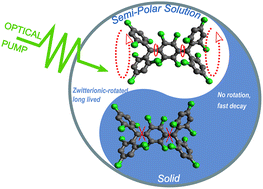
Stable fluorine and chlorine decorated Thiele-like diradicaloids were synthesized and studied in solution and in thin films. Femtosecond transient absorption measurements showed, for both molecules, charge-separated states in solution, but only short-lived singlets in thin films, with no evidence of twisted or charge-separated intermediates. This suppression of excited-state dynamics reflects the strong intermolecular interactions in the solid state and limits their singlet fission potential, highlighting key design challenges for implementing diradicaloids in solid-state optoelectronic and photovoltaic devices.
 Please wait while we load your content...


