


 PLATFORM UPDATE:


Low-dimensional transition metal dichalcogenide heterostructure photoanodes for photoelectrochemical hydrogen evolution application: recent progress and prospects
 *a
*a
Abstract
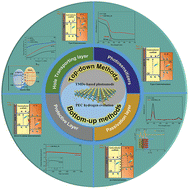
Solar-driven hydrogen evolution through photoelectrochemical (PEC) water splitting technology provides a prospective approach for green energy production. To accomplish reliable PEC systems with sufficient solar-to-hydrogen conversion efficiencies (STH, ≥10%), one of the current primary challenges lies in the design and fabrication of highly-performing semiconductor (SC) photoanodes to overcome its high overpotential requirement and sluggish surface oxidation kinetics. The emergence of low-dimensional layered transition metal dichalcogenides (TMDs) with extraordinary electronic and optical properties has gained considerable attention and they are inarguably promising photoanode candidates. The rational combination of TMDs interfaced with other SC photoabsorbers via energy band modulation and heterojunction formation can markedly improve PEC performance and solar conversion. In this context, this review begins with a description of the PEC water oxidation mechanism, efficiency-related parameters, band bending and charge transfer behavior within n-type SC photoanodes, followed by an overview of recent progress and our contributions in fabricating efficient TMD-based heterostructure photoanodes with various synthetic routes and architectures. Next, the unique superiorities and positive effects of TMD utilization, such as optimized light harvesting, regulated electron transfer channels, promoted charge separation and transport, and improved long-term photostability, were comprehensively summarized in various TMD/SC heterostructure photoanode systems. Finally, the remaining challenges and future opportunities in advancing TMD-based van der Waals heterostructure photoanodes for next generation PEC water splitting applications are addressed.
- This article is part of the themed collection: Power-to-X and Solar-to-X Technologies for a Net-Zero Future
 Please wait while we load your content...


