


 PLATFORM UPDATE:


Employing a cluster transfer strategy in a hybridisation chain reaction–silver nanocluster hybrid sensor for nucleic acid detection
 *a
*a
Abstract
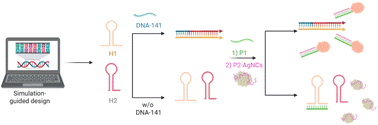
The hybridisation chain reaction (HCR) is a robust isothermal amplification technique widely used for nucleic acid detection, often paired with silver nanoclusters (AgNCs) for fluorescence-based readouts. However, conventional HCR–AgNC assays are prone to circuit leakage and unpredictable AgNC formation, which can compromise assay reliability. In this study, we present a modular HCR–AgNC hybrid sensor employing a cluster transfer strategy, in which pre-formed AgNCs are introduced separately into the HCR system. This design minimises interference between AgNCs and HCR components, enhancing signal specificity and predictability. Using a DNA analogue of miRNA-141 (DNA-141), a potential prostate cancer biomarker, we demonstrate selective red fluorescence activation upon target recognition. The sensor design was guided by NUPACK simulations, reducing trial-and-error and lowering assay costs. Gel electrophoresis and fluorescence spectroscopy confirmed the system's specificity and sensitivity, achieving a limit of detection of 46 nM. This work establishes a foundational framework for modular and adaptable nucleic acid biosensing, with potential for future sensitivity enhancements and multiplexed detection.
- This article is part of the themed collection: Analytical Methods HOT Articles 2026
 Please wait while we load your content...


