Issue 4, 2026

Ambient ionization strategies for the characterization of microbial systems via mass spectrometry

Abstract

Ambient ionization sources enable analysis via mass spectrometry (MS) with minimal sample handling and without vacuum-based ionization/sampling. The versatile nature of ambient ionization techniques makes them well suited for both high-throughput analyses and in situ spatial characterization. Ambient MS platforms such as desorption electrospray ionization (DESI-MS), direct analysis in real time (DART-MS), paper spray (PS-MS), and secondary electrospray ionization (SESI-MS) are particularly amenable for microbial analysis and have recently been utilized for rapid profiling of microorganisms and imaging of fragile substrates with complex biochemistries. This minireview aims to provide an overview of contemporary ambient ionization technologies coupled with MS and summarize the recent application areas of these strategies in the characterization of microbial systems via mass spectrometry over the past five years.
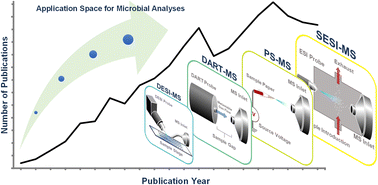
Graphical abstract: Ambient ionization strategies for the characterization of microbial systems via mass spectrometry

Article information

Article type
Minireview
Submitted
17 Nov 2025
Accepted
05 Jan 2026
First published
27 Jan 2026
This article is Open Access
Creative Commons BY-NC license

Analyst, 2026,151, 939-948

Ambient ionization strategies for the characterization of microbial systems via mass spectrometry

H. S. Shepard, J. C. May and J. A. McLean, Analyst, 2026, 151, 939 DOI: 10.1039/D5AN01214G

This article is licensed under a Creative Commons Attribution-NonCommercial 3.0 Unported Licence. You can use material from this article in other publications, without requesting further permission from the RSC, provided that the correct acknowledgement is given and it is not used for commercial purposes.

To request permission to reproduce material from this article in a commercial publication, please go to the Copyright Clearance Center request page.

If you are an author contributing to an RSC publication, you do not need to request permission provided correct acknowledgement is given.

If you are the author of this article, you do not need to request permission to reproduce figures and diagrams provided correct acknowledgement is given. If you want to reproduce the whole article in a third-party commercial publication (excluding your thesis/dissertation for which permission is not required) please go to the Copyright Clearance Center request page.

Read more about how to correctly acknowledge RSC content.

Social activity

Spotlight

Advertisements