Issue 12, 2025

Effect of fluorinated arylammonium halide passivation in chloride–iodide perovskite solar cells

Abstract

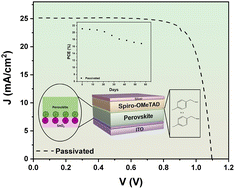
Due to the radius mismatch between iodine and chlorine, ion migration is unavoidable in chloride–iodide perovskites. The presence of atomic vacancies in the solution-processed perovskite thin film works as a route of ion migration. Here, we investigate the consequence of the ion migration in chloride–iodide perovskite solar cells. We use FA0.6MA0.4PbI2.7Cl0.3 as the active perovskite layer. We passivate the top surface of the chloride–iodide perovskite thin film with mixed 4-fluorobenzylammonium chloride and 4-fluorobenzylammonium bromide. We observe that fluorinated benzylammonium halides show better passivation and hydrophobicity. Compared to the non-passivated solar cells, we get a significant fill factor and stability improvement. We get 76.44% fill factor from our passivated solar cell. Besides, our passivated solar cell offers a photo conversion efficiency of 21.10%. Moreover, we also get about 80% stability without encapsulation after 56 days.

Graphical abstract: Effect of fluorinated arylammonium halide passivation in chloride–iodide perovskite solar cells

Supplementary files

Article information

Article type
Paper
Submitted
20 Jun 2025
Accepted
20 Oct 2025
First published
23 Oct 2025
This article is Open Access
Creative Commons BY-NC license

Energy Adv., 2025,4, 1529-1540

Effect of fluorinated arylammonium halide passivation in chloride–iodide perovskite solar cells

A. H. Howlader, Y. Yao, R. Kuchel and A. Uddin, Energy Adv., 2025, 4, 1529 DOI: 10.1039/D5YA00164A

This article is licensed under a Creative Commons Attribution-NonCommercial 3.0 Unported Licence. You can use material from this article in other publications, without requesting further permission from the RSC, provided that the correct acknowledgement is given and it is not used for commercial purposes.

To request permission to reproduce material from this article in a commercial publication, please go to the Copyright Clearance Center request page.

If you are an author contributing to an RSC publication, you do not need to request permission provided correct acknowledgement is given.

If you are the author of this article, you do not need to request permission to reproduce figures and diagrams provided correct acknowledgement is given. If you want to reproduce the whole article in a third-party commercial publication (excluding your thesis/dissertation for which permission is not required) please go to the Copyright Clearance Center request page.

Read more about how to correctly acknowledge RSC content.

Social activity

Spotlight

Advertisements