


 PLATFORM UPDATE:


Assessing the impact of enhanced model resolution on heatwave prediction during June 2023
 b
Harvir
Singh,
ac
Anumeha
Dube,
a
Arun
Chakraborty,
*b
M. N. Raghavendra
Sreevathsa,
a
Raghavendra
Ashrit
a
and
V. S.
Prasad
a
b
Harvir
Singh,
ac
Anumeha
Dube,
a
Arun
Chakraborty,
*b
M. N. Raghavendra
Sreevathsa,
a
Raghavendra
Ashrit
a
and
V. S.
Prasad
a
Abstract
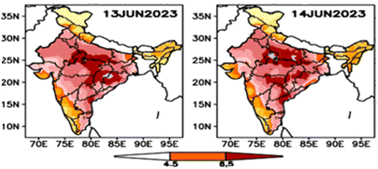
Heatwaves are extreme weather events characterized by prolonged periods of unusually high temperatures, often leading to severe impacts on health, economy, and infrastructure. Global numerical weather prediction (NWP) models are useful for heatwave prediction, but they often underestimate the intensity due to their coarse resolution. To address this, experiments with high-resolution NWP models are required to better capture the intensity of heatwaves. In this study, we conducted an experiment using the National Centre for Medium Range Weather Forecasting (NCMRWF) Global Unified Model (NCUM-G) in two configurations: 12 km (Exp12) and 6 km (Exp06) resolutions, both initialized with identical conditions. To assess their performance, forecasts from the two versions were evaluated against the India Meteorological Department's (IMD) gridded observations using the mean error (ME) for the extreme heatwave over eastern India during 14–19 June 2023. The observed maximum temperature (Tmax) during this event reached 42–46 °C, well above the climatological 32–36 °C, mainly due to a ridge over eastern India and delayed monsoon onset from cyclone Biparjoy. Results show that Exp06 provided superior accuracy at shorter lead times (Day 1 and Day 3), closely capturing the observed heatwave intensity, while Exp12 outperformed Exp06 at longer lead times (Day 5). Regional verification revealed that Exp06 forecasts aligned particularly well with observations over Uttar Pradesh and Bihar, while both models showed comparable performance over Jharkhand and Odisha. These findings highlight the trade-offs between the resolution and forecast range in global models and demonstrate that high-resolution experiments can substantially improve short-range predictions of extreme heatwaves in India.
 Please wait while we load your content...


