


 PLATFORM UPDATE:


Climate variability and flow management impact phytoplankton biomass in a shallow reservoir
 *a
Kristin J.
Painter,
a
Ali
Nazemi,
b
Jason J.
Venkiteswaran
c
and
Helen M.
Baulch
a
*a
Kristin J.
Painter,
a
Ali
Nazemi,
b
Jason J.
Venkiteswaran
c
and
Helen M.
Baulch
a
Abstract
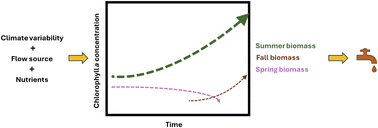
Shallow, eutrophic lakes often exhibit high and extremely variable phytoplankton biomass. This variability makes drinking water supply from shallow lakes particularly vulnerable to rapid change, as phytoplankton blooms can strongly impact treatment processes. Using 39 years of water quality data (typically bi-weekly), this study investigates the roles of climate variability and flow management in driving change in chlorophyll a (an indicator of phytoplankton biomass) in a shallow, hydrologically managed drinking water reservoir. Generalized additive modelling shows a significant increase in phytoplankton biomass (1992–1997), leading to a doubling of average chlorophyll a concentrations. Interestingly, we also see a shift towards smaller spring blooms and larger summer blooms. Our results show this variability in phytoplankton is largely related to climate variability, nutrients, and flow source. Specifically, the increase in phytoplankton biomass coincided with periods with greater precipitation and associated nutrient-rich inflows from an agriculturally dominated catchment, along with strong El Niño events that potentially contributed to a warm, stable water column during the growing season. During high flows from the local catchment, flows from the upstream supply reservoir are typically reduced to prevent downstream flooding. However, flows from the supply reservoir have a diluting impact due to its lower nutrient concentrations. Thus, where reservoir flow sources vary in chemistry, considering water quality in flow management could help to ameliorate bloom severity and reduce drinking water treatment costs. Importantly, understanding management and climatic drivers of reservoir water quality contributes to advance planning and mitigation of risks to water treatment.
 Please wait while we load your content...


