


 PLATFORM UPDATE:


Luminescence and upconversion properties of a novel ultraviolet-C emitting phosphor: Rb2NaYF6:Pr3+
 *a
Alexander
Grippa,
b
Patrycja
Zdeb-Stańczykowska,
a
Aleksejs
Zolotarjovs,
c
Anatoli I.
Popov
c
and
Przemysław J.
Dereń
a
*a
Alexander
Grippa,
b
Patrycja
Zdeb-Stańczykowska,
a
Aleksejs
Zolotarjovs,
c
Anatoli I.
Popov
c
and
Przemysław J.
Dereń
a
Abstract
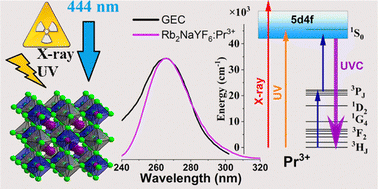
Ultraviolet C radiation (UV-C, 220–280 nm) effectively destroys the DNA of pathogenic microorganisms and malignant cells, making it an essential tool for sterilization, disinfection, and cancer treatment. The development of efficient UV-C-emitting phosphors is critical for advancing such applications. In this paper, we present a new praseodymium-doped phosphor Rb2NaYF6 that produces intense emission in the 225–350 nm spectral region upon excitation with X-rays, UV light, and a 444 nm laser. This emission arises from the 5d14f1 → 4f2 electronic transitions of Pr3+ ions. The key focus of this work is the process of vis-to-UVC up-conversion. We systematically studied how the radiation intensity during up-conversion depends on the praseodymium concentration and pump power. It was found that the ESA up-conversion mechanism is responsible for the up-conversion under pulsed laser excitation. The optimum concentration of the activator was determined to be 2.5 mol%, which is relatively higher than in previous studies of our matrices. It should be noted that the up-conversion radiation intensity of Rb2NaYF6:Pr3+ significantly exceeds that of BaYF5:Pr3+, highlighting its potential as a highly efficient UV-C emitter for medical and industrial applications.
- This article is part of the themed collection: Celebrating International Women’s Day 2026: Women in Journal of Materials Chemistry C
 Please wait while we load your content...


