


 PLATFORM UPDATE:


Improving the performance of polarization conversion in the near-infrared with low insertion loss by the metasurface
 a
Hai-Feng
Zhang
*a
a
Hai-Feng
Zhang
*a
Abstract
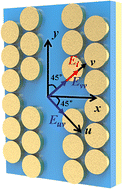
When operating in the near-infrared band (NIB), the performance of the linear to circular polarization conversion (LTCPC) metasurface (MS) is significantly impacted by the electromagnetic loss and the device will generate plenty of thermal radiation. In view of this problem, a method based on the substrate integrated waveguide (SIW) like cavity is proposed in this work. Subsequently, a comprehensive theoretical analysis is conducted by combining the phase and amplitude of the reflection, which confirmed that a well-designed SIW-like cavity can effectively reduce the insertion loss (IL) and indirectly improve the bandwidth. Using an equivalent circuit model, the mechanism of low IL is systematically summarized. Observations of the current and electromagnetic energy distribution showed that a low insertion loss technique (LILT) can interrupt continuous currents, inducing and reactivating the directionality, density, and intensity of surface currents. The presented work not only explains the operating principle of low IL but also offers a more straightforward and convenient method for creating broadband and low IL LTCPC MSs in the NIB.
 Please wait while we load your content...


