


 PLATFORM UPDATE:


An integrative study to unlock the self-assembling and interaction studies of chromium-based metallo–catanionic surfactant mixtures with cytochrome c
 a
and
Gurpreet
Kaur
*a
a
and
Gurpreet
Kaur
*a
Abstract
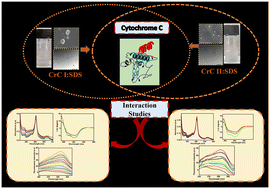
Surfactant–protein interactions have ever been a topic of discussion for a number of reasons, but understanding the aggregation of proteins is of utmost importance. Cytochrome c (cyt c) is an important heme protein and is not only involved in many amyloid-related disorders but is also responsible for many biological functions such as electron transport chains. Herein, the interactions of the protein with metallo–catanionic vesicles prepared using various molar ratios of cationic metallosurfactants (hexadecyl trimethyl ammonium chromium trichloride (CrC I) and bishexadecyl trimethyl ammonium chromium tetrachloride (CrC II)) and anionic sodium dodecyl sulphate (SDS) were analyzed. Comparative studies were carried out to evaluate the role of hydrophobicity (using single- and double-chain metallosurfactants), presence of a metal ion and surface charge in interactions with this water-soluble protein. Metallo–catanionic aggregates were characterized using various analytical techniques such as conductivity, dynamic light scattering (DLS), field-emission scanning electron microscopy (FESEM), high-resolution transmission electron microscopy (HRTEM), zeta potential analysis, and small-angle X-ray scattering (SAXS). The aggregates formed either had a spherical or a disc-like structure. From all the prepared molar ratios, 70 : 30 and 30 : 70 were selected on the basis of stability, as evident from zeta potential and DLS analyses. Further, the selected aggregates were investigated for their influence on the primary, secondary and tertiary structures of the selected protein. SDS-PAGE experiments revealed that the primary structure of cyt c remained intact at all the studied concentrations of single-chain metallosurfactant aggregates; however, higher concentrations of double-chain metallo–catanionic vesicles showed some influence on the primary structure. The secondary structure of the protein was impacted by both electrostatic and hydrophobic interactions, as evident from CD analysis. Extensive fluorescence experiments helped us conclude that the aggregates formed a ground-state complex with the protein without affecting its heme structure. The complex structure was formed due to the involvement of both polar and non-polar forces.
 Please wait while we load your content...


