


 PLATFORM UPDATE:


Hollow ZSM-11 zeolite synthesized via slow aluminum release: enhanced acid accessibility and stability in methanol-to-olefins

Abstract
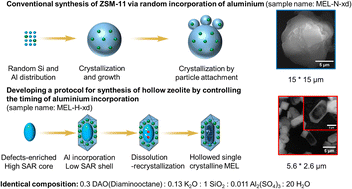
The catalytic activity of zeolites is predominantly determined by mass transfer within the molecularly confined channels. Hollow zeolite architectures offer superior mass transport characteristics and enhanced accessibility to active sites. While conventional synthesis predominantly relies on multi-step hard-templating or post-treatment strategies, the one-pot synthesis of hollow zeolite crystals remains a significant challenge. In this work, we report a novel one-pot synthesis of hollow zeolites using a slow-releasing aluminum source prepared via complexation of an amine-based structure-directing agent with an aluminum salt. This approach successfully produced hollow MEL-type zeolite crystals with a uniform shell thickness of approximately 90 nm and an internal cavity diameter of around 2.5 μm. Mechanistic studies revealed that the hollow structure results from a dissolution–recrystallization process driven by the biased Al and Si dissolution rates, which gradually transforms amorphous Si-enriched aggregates into crystalline hollow zeolites. Compared to conventional solid MEL crystals, the hollow zeolite exhibits enhanced Brønsted acid concentration and strength, along with improved aluminum distribution within the straight channels. The hollow zeolite catalyst demonstrated superior catalytic performance in the methanol-to-olefins (MTO) reaction, achieving a complete methanol conversion, an increased propylene selectivity (41% vs. 33%), and a significantly extended catalyst lifetime (26.5 h vs. 11.5 h) compared to its conventional counterpart. This work provides an efficient route for synthesizing hollow zeolites, offering new opportunities for the rational morphological design of high-efficiency zeolite catalysts.
 Please wait while we load your content...


