


 PLATFORM UPDATE:

Multi-scale nanoemulsion-directed anisotropic assembly for hierarchically porous metal–organic frameworks

Abstract
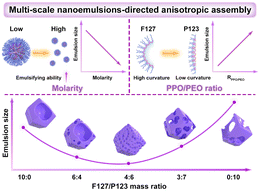
Anisotropic hierarchically porous metal–organic framework (MOF) nanomaterials hold great promise for heterogeneous catalysis by virtue of their diverse coordination networks, programmable catalytic functionalities, and enhanced mass diffusion. However, achieving simultaneous control over structural symmetry of MOF nanoparticles and the integration of tunable mesoporosities within the MOF matrix remains a significant challenge. Herein, we present a multi-scale nanoemulsion-directed anisotropic assembly strategy to fabricate mesoporous ZIF-67 nanobowls with highly adjustable pore structures. This approach employs a dual-surfactant system (F127 and P123) to stabilize nanoemulsions of distinct sizes. The smaller nanoemulsions are encapsulated within the growing MOF matrix to generate internal mesopores, and the larger nanoemulsions serve as the nucleation interface to guide their anisotropic assembly. By adjusting the mass ratio of F127 to P123, we modulate both the overall surfactant molarity and the hydrophilic to hydrophobic segment ratio, leading to a non-monotonic evolution in nanoemulsion size. The fine control enables the synthesis of a library of ZIF particles, including both anisotropic and isotropic morphologies with tunable pore structures. Furthermore, by altering the metal source or applying an epitaxial growth strategy, this strategy can be extended to the fabrication of other ZIF-type MOFs and sophisticated core–shell hierarchical structures. Benefiting from the bowl-shaped hierarchically porous nanostructure that promotes reactant enrichment and accelerated mass transport, the resultant mesoporous ZIF-67 nanobowls exhibit fabulous catalytic activity in the carbon dioxide cycloaddition reaction. This work establishes a versatile platform for constructing hierarchically multimodal porous MOFs via multi-scale nanoemulsion-driven anisotropic assembly, offering new avenues for applications in advanced catalysis, energy conversion, and biomedicine.
 Please wait while we load your content...


