


 PLATFORM UPDATE:

Avoiding surface defect-catalyzed oxidation for extraordinary thermoelectric performance in n-type iodine-doped PbTe compounds
 e
Jinsong
Wu,
bf
Vladimir
Khovaylo,
g
Pierre Ferdinand Poudeu
Poudeu,
h
Xianli
Su
*ab
and
Xinfeng
Tang
*ab
e
Jinsong
Wu,
bf
Vladimir
Khovaylo,
g
Pierre Ferdinand Poudeu
Poudeu,
h
Xianli
Su
*ab
and
Xinfeng
Tang
*ab
Abstract
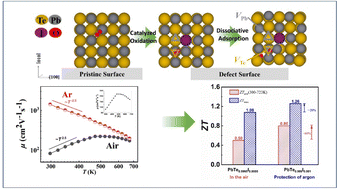
In n-type PbTe compounds with low optimal carrier concentrations (∼1019 cm−3), structural defects critically govern charge transport. While defect engineering typically focuses on chemical composition or synthesis optimization, atmospheric control remains an overlooked dimension. Herein, we establish atmospheric control as a new defect-engineering dimension, demonstrating that oxygen exposure during mechanical grinding fundamentally changes defect evolution and thermoelectric properties in n-type I-doped PbTe systems. The PbTe0.998I0.002 sample achieves a peak ZT of 1.26 at 773 K and the PbTe0.999I0.001 sample exhibits a superior average ZT of 0.8 over 298–723 K when ground in Ar, significantly outperforming air-ground counterparts (ZTmax = 1.08; ZTave = 0.5). First-principles calculations reveal that mechanically generated surface vacancies modify the preferential oxygen adsorption sites from the pristine Te-top position to Te-vacancy sites on defective surfaces, substantially reducing both oxygen adsorption energy and dissociation barriers. Moreover, iodine dopants and oxygen synergistically lower the formation energy of VPb2−, which intensifies carrier scattering via Coulomb interactions, reducing mobility to merely 300 cm2 V−1 s−1. Conversely, Ar protection effectively prevents oxygen contamination and suppresses O–I mediated VPb2− formation, enabling a remarkable carrier mobility of 1800 cm2 V−1 s−1 in the lightly doped PbTe0.999I0.001 sample with comparable carrier concentration, and yielding an ultrahigh power factor of 35 µW cm−1 K−2 at room temperature. This work provides critical guidelines for optimizing thermoelectric performance in oxygen-sensitive material systems where mechanochemical fracture processes occur.
 Please wait while we load your content...


