


 PLATFORM UPDATE:


Significantly enhanced capacitive energy-storage performance of a flexible P(VDF-CTFE)-polyimide bilayer by optimizing the interface effect

Abstract
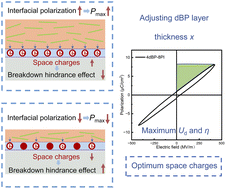
Polymer film capacitors are vital for power electronic systems due to their ultrafast charge–discharge capability, high power density, mechanical flexibility, and lightweight nature. However, achieving both high discharge energy density (Ud) and high energy-storage efficiency (η) in polymer dielectrics remains a major challenge due to the intrinsic trade-off between permittivity, electric polarization, and breakdown strength. In this study, we have designed bilayer heterogeneous nanocomposites (BHNs) that integrate a linear polyimide (PI) layer—offering low dielectric loss and high breakdown strength—with a ferroelectric P(VDF-CTFE) matrix embedded with dopamine-modified BaTiO3 nanowires (dopa@BT NWs), which imparts high polarization. By precisely tuning the thickness of each layer and the interfacial charge accumulation, we activate synergistic interfacial polarization and a breakdown hindrance effect. More importantly, we propose the concept of a “threshold concentration of interfacial space charge”, which governs the critical charge density required to maximize performance without triggering dielectric instability. As a result, the optimized BHNs (0.3 vol% dopa@BT NWs/P(VDF-CTFE)-PI, whose thicknesses are 4 µm and 8 µm, respectively) exhibit a significantly enhanced Ud of up to 11.1–14.1 J cm−3 and a high η of 72–86%, substantially surpassing conventional single-layer configurations. This work not only delivers promising candidates for advanced dielectric energy-storage applications but also introduces a physically grounded design model that offers guidance for next-generation high-performance polymer-based capacitors.
 Please wait while we load your content...


