


 PLATFORM UPDATE:


From alloy composition to battery performance: a machine learning strategy for the design of Mg–air battery anodes
 *ab
*ab
Abstract
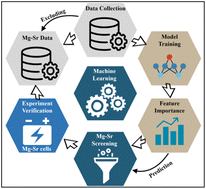
Developing new magnesium (Mg) alloy anodes is a crucial pathway to improve the performance of Mg–air batteries; however, identifying suitable elements and alloy compositions is impractical by the “trial-and-error” method. Here, we propose a machine learning strategy to design Mg anodes with new elements beyond the existing dataset. The discharge performance of magnesium–strontium (Mg–Sr) alloys as anode materials is successfully predicted, despite the absence of Mg–Sr alloys in the training dataset. And two descriptors—Eea and M2.Mg—are identified as being strongly correlated with the specific energy of Mg–air cells. The specific energy of Mg–air batteries exceeds 1600 mWh g−1 if Eea ≥ 13.5 and M2.Mg ≤ 0.14 or ≥0.30 with a screening success rate of over 30%. Experimental validation further substantiates the viability of this framework, demonstrating that the Mg–0.1Sr alloy exhibits superior performance, with a specific energy of 1872 mWh g−1 in an Mg–air battery. This work introduces a data-driven and predictive paradigm for designing novel Mg alloys.
 Please wait while we load your content...


