


 PLATFORM UPDATE:


Se-doped sulfurized polyacrylonitrile as a high-performance anode for stable K-ion storage

Abstract
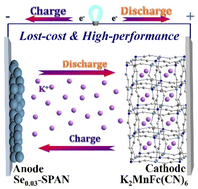
Developing high-performance electrode materials for non-aqueous K-ion batteries (KIBs) is crucial for their further practical applications. Sulfurized polyacrylonitrile (SPAN), as a sulfur–carbon composite, is an attractive anode candidate for KIBs due to its low cost, high capacity and remarkable lifespan. To further boost its electrochemical performance toward K-ion storage, herein, a small amount of selenium (Se) is used as a eutectic accelerator to significantly improve the rate performance of SPAN-based materials. The doped Se is homogenously distributed at the atomic level and is conducive to promoting the reaction kinetics and K-ion diffusion. As a result, the optimized Se0.03-SPAN exhibits a high reversible capacity around 556 mA h g−1, exceptional rate capability with a capacity of 361.1 mA h g−1 at 2.0 A g−1, and impressive cycling stability with no capacity decay over 1200 cycles. Moreover, the full cell consisting of Se0.03-SPAN and high-voltage K2MnFe(CN)6 reveals an appealing energy density (291.7 Wh kg−1), decent rate capability (86.9 mA h g−1 at 3.0 C), and an unprecedented lifespan (4300 cycles with 77.5% capacity retention). This study demonstrates the promoting effect of Se in SPAN and a promising K-ion full cell with high performance and low cost, endowing KIBs with a competitive potential in large-scale energy storage applications.
 Please wait while we load your content...


