


 PLATFORM UPDATE:


Over-discharge-induced capacity degradation mechanisms in large-capacity semi-solid-state lithium-ion batteries

Abstract
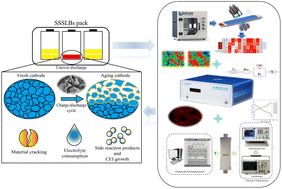
Semi-solid-state lithium-ion batteries (SSSLBs) integrate the safety merits of solid-state electrolytes with the interfacial compatibility of liquid phases, yet their aging mechanisms under over-discharge remain insufficiently elucidated, especially for large-format cells. This study investigates 28 Ah pouch-type SSSLBs with NCM cathodes using a CCCV–CCCV protocol that emulates module-level over-discharge. Through a multi-scale framework combining electrochemical impedance spectroscopy, cyclic voltammetry, ultrasonic non-destructive mapping, and post-mortem SEM/EDS analysis, we unveil a cathode-dominated degradation pathway: repetitive H2 → H3 phase transitions induce anisotropic strain, triggering intergranular fracture and micro-crack propagation that accelerate CEI thickening and active-material loss. Concurrently, graphite–silicon anode breathing causes SEI reformation, while solid-electrolyte coating decomposition destabilizes interfaces. Crucially, liquid electrolyte depletion exacerbates wetting deterioration, increasing interfacial impedance. Importantly, this work provides the first systematic evidence that over-discharge failure in large-capacity pouch-type SSSLBs is fundamentally different from that in small cylindrical cells. While the latter is governed by anode lithium plating and copper dissolution, large-format SSSLB degradation is dominated by cathode structural disintegration and interfacial contact loss. These insights inform BMS strategies and safe-design principles for industrial-scale SSSLB packs.
 Please wait while we load your content...


