


 PLATFORM UPDATE:


Thermally tuned oxygenated covalent triazine framework via self-templating for a durable 3.8 V aqueous supercapacitor with record energy and power density
 c
Sanjib
Das
*ab
c
Sanjib
Das
*ab
Abstract
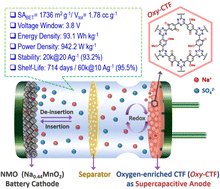
High-voltage (>2 V) aqueous supercapacitors (SCs) showing high energy and power density offer a sustainable, safe, eco-friendly, and cost-effective alternative to organic electrolyte-based SCs, bridging the gap between batteries and capacitors. Herein, we report the modular synthesis of oxygen-rich covalent triazine frameworks (Oxy-CTFs) showing a large surface area (2543 m2 g−1) and pore volume (2.95 cm3 g−1) via ZnCl2-mediated ionothermal polymerization using a cost-effective 2,5-dimethoxy terephthalonitrile monomer (LOMe). The strategically embedded methoxy groups serve as both a monomer and soft self-template. Apart from its catalytic role, ZnCl2 as an activating agent/porogen simultaneously induces partial in situ O-demethylation, carbonization, and structural rearrangement, enriching the electroactive carbonyl/quinone species and graphitic domains embedded with pyrrolic and pyridinic nitrogen functionalities in the resulting Oxy-CTFs. Combined, these features enhance the charge-storage capability, ion-transport kinetics, and faradaic activities. In a symmetric SC, Oxy-CTFs delivered a record voltage of 3.1 V, capacitance of 239.4 ± 6.5 F g−1, and energy and power densities of 79.5 ± 1.98 Wh kg−1/387.3 ± 10.5 W kg−1, respectively. In a hybrid SC (Na0.44MnO2 as the battery-type cathode), the voltage extended to 3.8 V, achieving the highest energy and power densities of 93.1 ± 2.1 Wh kg−1/942.2 ± 21.2 W kg−1, respectively. Furthermore, it demonstrated remarkable cycling stability, with 93.2% capacity retention after 20 000 cycles (20 A g−1) and maintained 95.5% after 60 000 repeated cycles with a cell shelf-stored for 714 days. This rational soft self-templating approach sets a new performance benchmark in aqueous SC research.
 Please wait while we load your content...


